
Can Work Light Bars be used on public roads?
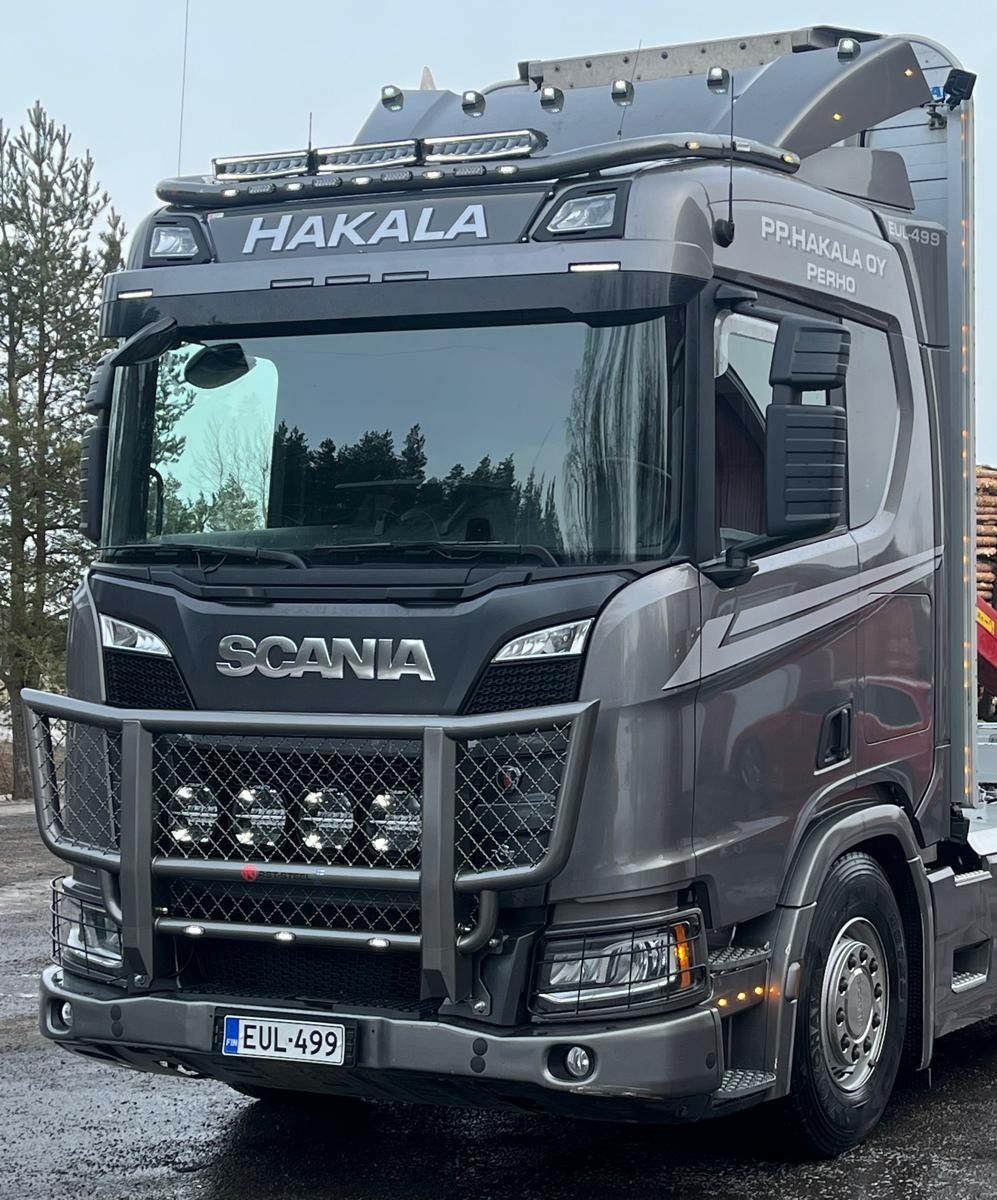
Work light bars cannot be used on public roads while driving in Finland or anywhere in the EU. They are classified as work lights under ECE regulations and are explicitly prohibited from active use during road transit. Understanding the distinction between work light bars and road-legal auxiliary lights, the relevant regulations, and the consequences of non-compliance is essential for every professional driver operating a truck or heavy vehicle.
What exactly are work light bars and how do they differ from road-legal auxiliary lights?
Work light bars are high-intensity lighting units designed to illuminate large work areas at close to medium range. They typically produce between 5,000 and 30,000 lumens and use either wide-angle flood beam configurations (beam angles of 60–120°) or focused spot beams (10–30°), or a combination of both. Their photometric output is engineered for stationary work environments, not for road traffic.
Road-legal auxiliary driving lights, by contrast, carry ECE R112 or R149 type approval and are engineered to project a controlled, asymmetric beam that avoids dazzling oncoming drivers. They must meet strict cut-off line requirements and maximum intensity limits defined under EU Directive 76/756/EEC. Work light bars carry no such approval because their beam patterns would blind oncoming traffic at any realistic road speed. The E-mark on a lamp tells you its approved function. If it does not carry R112 or R149 approval, it is not road-legal as a driving light.
Are work light bars legal to use while driving on public roads in Finland and the EU?
No. Using a work light bar while in motion on a public road is illegal under Finnish and EU law. The Finnish Road Traffic Act (Tieliikennelaki 729/2018) prohibits the use of lights that cause undue dazzle or are not type-approved for road use. EU Directive 76/756/EEC and its successive amendments define precisely which lamp categories may be activated during road driving.
ECE Regulation R10 and the broader vehicle lighting framework distinguish clearly between “use while stationary” and “use while in motion.” Work lights fall into the stationary-use category only. Finnish enforcement authorities interpret any forward-facing, high-intensity light without proper E-mark approval as an illegal road-use device if it is wired to be operable while the vehicle is moving. The regulation does not require the light to be physically switched on during a stop — if it can be activated while in motion, the installation itself may be considered non-compliant.
What are the legal mounting and wiring requirements for auxiliary lights on trucks?
Finnish and EU regulations set precise rules for auxiliary light installations. Forward-facing lights must be mounted no higher than 1,500 mm from the ground for certain categories, and no more than four forward-facing lights may be active simultaneously on a standard truck. Lateral placement must keep lights within the vehicle’s outer edge profile.
Wiring is where most installations fail katsastus (roadworthiness inspection). Work light bars must be wired through a mandatory interlock system that physically prevents activation above a set speed, typically linked to the vehicle’s CAN bus or a dedicated speed signal. A separate, clearly labelled switch circuit is required, and the switch must be inaccessible or inoperative during normal road driving. Any installation that allows a work light bar to be switched on while the vehicle is moving will result in a failed inspection. Type-approval documentation for every lamp fitted must be available for the inspector.
What happens if you use a work light bar on a public road illegally?
The consequences go well beyond a traffic fine. Police can issue an on-the-spot fine and order the vehicle off the road until the lighting fault is corrected. A subsequent failed roadworthiness inspection can ground the vehicle entirely, disrupting delivery schedules and contractual obligations.
The commercial risk is more serious. If an accident occurs while an illegal work light bar is active, the vehicle’s insurer may reduce or deny liability coverage on the grounds that the vehicle was in a non-compliant state. For transport companies, a pattern of lighting violations can trigger scrutiny from Traficom and jeopardise the operator’s licence. The reputational and financial exposure for a professional haulier far outweighs any perceived operational benefit from running work lights on the road.
How can professional drivers use work light bars safely and legally in their operations?
Work light bars are entirely legal and highly effective in the right context. Approved use cases include active worksites, loading and unloading areas, off-road terrain, forestry operations, and any stationary application where the vehicle is not on a public road. The key is ensuring the installation prevents road-use activation.
- Install a speed-interlock relay that cuts power to the work light circuit above 5–10 km/h
- Use a dedicated, labelled switch panel with a separate fused circuit
- Mount lights on purpose-built stainless steel work light brackets designed for the specific truck model
- Ensure all wiring is sealed and routed away from heat sources to maintain long-term compliance
- Keep type-approval documentation and installation records in the vehicle for inspection purposes
At RST-Steel, we manufacture and supply purpose-built work light bar mounting systems for the most common truck brands, and we provide complete installation services that meet Finnish roadworthiness standards from the ground up. If you want a compliant, professionally installed lighting setup that works hard on site and stays legal on the road, contact us for a consultation and we will find the right solution for your vehicle and operation.


 Norwegian
  English
  Swedish