
When Are Work Lights Allowed on a Vehicle?
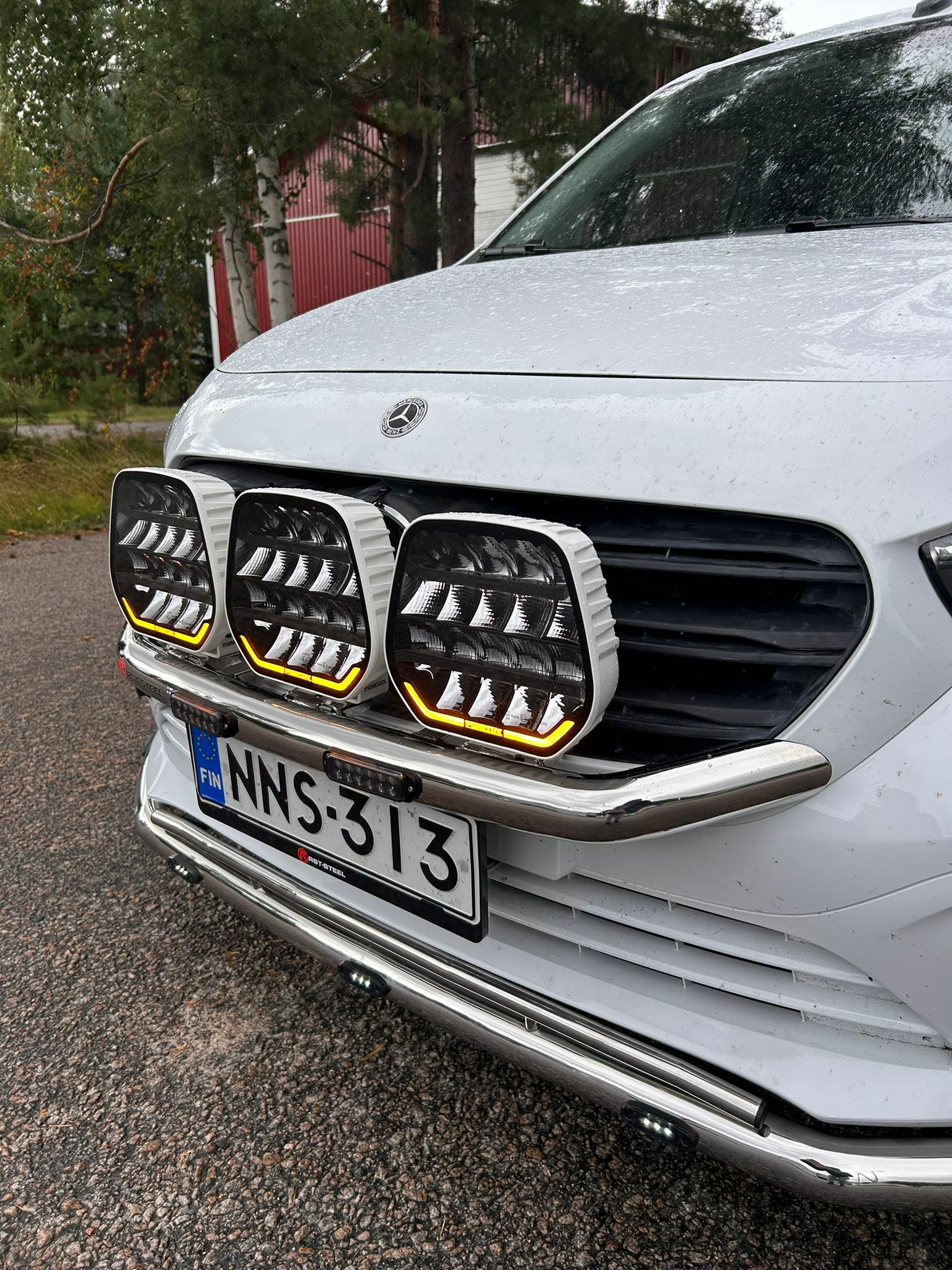
Work lights may only be used on private land and work sites, not on public roads in traffic. In traffic, work lights must be turned off, as they can dazzle other road users. Vehicle lighting regulations across Nordic countries specify exactly when auxiliary lights may be used and the technical requirements for their installation.
Work lights in vehicles – what does the law say about their use in Nordic countries?
Nordic countries including Finland, Sweden, Norway, and Denmark have harmonized vehicle lighting regulations that strictly control auxiliary lighting. The Finnish Traffic Act and Vehicle Decree, Swedish Transport Agency regulations (Transportstyrelsen), and corresponding Norwegian and Danish legislation all classify work lights as auxiliary lights subject to strict restrictions on public roads.
Across the Nordic region, auxiliary lights laws define work lights as supplementary lighting designed to improve visibility in special conditions. Examples include premium Lazer Lamps lights, which provide exceptionally bright light distribution for demanding conditions. Sweden’s vehicle regulations (Fordonsförordningen) and Finland’s Vehicle Decree contain nearly identical requirements for auxiliary lighting installations.
Before installing auxiliary lights, it is important to understand that all Nordic countries require that lights installed on vehicles must not affect their roadworthiness inspection eligibility. Work lights must be installed in a way that does not create hazards in traffic, with Sweden’s Transport Agency and Finland’s Traficom enforcing similar safety standards.
When are work lights allowed in traffic across Nordic countries?
The use of work lights on public roads is prohibited while driving throughout Finland, Sweden, Norway, and Denmark. They must be turned off immediately when moving from private land to a public road. Swedish regulations specifically state that auxiliary lights (extraljus) must not be used on public roads during normal driving conditions.
The only exception across Nordic countries is when the vehicle is parked or stopped at the roadside and the work lights are used as warning lights. Even then, special care must be taken to avoid dazzling other road users. Norway’s vehicle regulations emphasize that auxiliary lights must not interfere with other traffic participants.
Vehicle lighting regulations in all Nordic countries also prohibit the use of auxiliary lights that could confuse other road users. Work lights can be so bright that they create hazardous situations in traffic, which is why enforcement is strict across Sweden, Finland, Norway, and Denmark.
What are the technical requirements for work lights in Nordic countries?
Work lights must be securely mounted to the vehicle structure according to both EU directives and national Nordic regulations. They must withstand vehicle vibration and harsh Nordic weather conditions without coming loose or being damaged. Swedish and Finnish regulations require identical mounting standards for auxiliary lighting systems.
Light output must not exceed certain limits defined by EU regulations, which are enforced consistently across Nordic countries. The lights must be aimed so they do not dazzle oncoming vehicles. High-quality LED lights, such as Lazer Lamps products, often have adjustable mounts to ensure correct alignment that meets both Swedish Transport Agency and Finnish Traficom requirements.
ECE approval markings and CE certification are mandatory for lights sold throughout the Nordic region and EU. Additionally, the lights must meet IP protection class requirements, ensuring durability against moisture and dust – particularly important in Nordic climates. Sweden requires ECE R112 or ECE R7 approval for auxiliary lights, similar to other Nordic countries.
Can work lights be used on private land and construction sites in Nordic countries?
On private land throughout Nordic countries, work lights may be used freely as long as they do not disturb neighbors or cause light nuisance. Swedish environmental regulations and Finnish municipal ordinances both address light pollution concerns. On construction sites across the region, work lights are often essential for safety during the long Nordic winter months.
On forest roads and in off-road areas throughout Sweden, Finland, Norway, and Denmark, work lights significantly improve visibility and driving safety. This is especially important given the extensive forestry operations and outdoor recreation activities common across Nordic countries. In winter conditions with limited daylight hours, good lighting is critically important for safety.
Work lights are also permitted and recommended for agricultural work and other tasks on private land across all Nordic countries. Sweden’s large agricultural sector and Finland’s forestry industry both benefit from auxiliary lighting for equipment operation. It is important to remember to turn off the lights before moving onto public roads in any Nordic country.
Key considerations when purchasing work lights in Nordic countries – summary
Choosing the right lighting solution requires consideration of the intended use and compliance with Nordic regulations. Work lights are best suited for private land, construction site use, and off-road driving throughout Finland, Sweden, Norway, and Denmark.
The advantage of high-quality lights, such as Lazer Lamps products, is their long service life and reliability in harsh Nordic conditions. The five-year warranty demonstrates the manufacturer’s confidence in the product’s quality and durability in extreme weather conditions common across the Nordic region.
When installing, attention should be paid to safe mounting and proper aiming that meets both EU directives and national Nordic requirements. Professional installation ensures that the lights function optimally and safely in all conditions while maintaining compliance with Swedish, Finnish, Norwegian, and Danish regulations.
Kontakta oss
Explore our selection and get in touch to find auxiliary lights that suit your exact needs and comply with Nordic country regulations.
Related Posts
Can Sun Visors be adjusted to different positions?
Yes — truck sun visors adjust in multiple ways. Here’s what every professional driver should know.
Which Cabin Outside accessories should be installed on a truck?
Protect your truck and improve safety with the right cabin exterior accessories for professional drivers.
How does Cabin Inside affect driver well-being?
Poor cabin ergonomics silently drains driver alertness — discover which interior accessories make the biggest difference on long hauls.
Which seat covers are suitable for professional use?
Not all seat covers handle daily cab life. Find out which materials and features truly meet professional standards.
Which Work Light Bars are the most efficient on a truck?
Not all truck light bars are equal — discover which specs, beam patterns, and ratings truly deliver on the job.
Can Work Light Bars be used on public roads?
Work light bars are illegal on EU public roads — here’s what every professional truck driver must know.
Can Front Spoiler Bars be repaired after damage?
Damaged front spoiler bar? Discover repair methods, assessment tips, and when replacement beats repair costs.
Which Front Spoiler Bars withstand impacts best?
Not all front spoiler bars survive real-world punishment — material grade, weld quality, and bracket engineering make all the difference.
How do Front Spoiler Bars affect a truck’s air resistance?
Front spoiler bars do more than manage airflow — discover their real aerodynamic impact and practical benefits for truck drivers.
When should Wheel Covers be replaced?
Damaged truck wheel covers risk costly rim repairs and road safety hazards — here’s exactly when to replace them.
How should Wheel Covers be cleaned effectively?
Brake dust, road salt, wrong cleaner — discover the step-by-step wheel cover cleaning routine that protects your rims long-term.
Which lights work best on a Roof Bar?
LED vs halogen, beam patterns, and key specs — find the best roof bar lights for professional trucks.
Which Front Bars fit different truck models?
Discover which stainless steel front bars fit major European truck models — and how to choose the right one.
How should Cabin Inside cleaning be carried out professionally?
Master professional truck cabin cleaning with the right tools, techniques, and schedules every driver needs.
How can Cabin Inside lighting be improved?
Discover how the right truck cabin lighting reduces driver fatigue and transforms your cab into a productive workspace.
Which Front Spoiler Bars are suitable for city driving?
Protect your truck’s front bumper in city traffic — discover which front spoiler bars handle urban hazards best.
What are Front Spoiler Bars on a truck?
Discover how front spoiler bars shield truck bumpers from real-world hazards — reducing costly downtime and repair bills.
Is a Bull Bar mandatory on a truck?
Bull bars aren’t mandatory on trucks — but here’s why professional drivers treat them as essential.


 Swedish
  English
  Norwegian