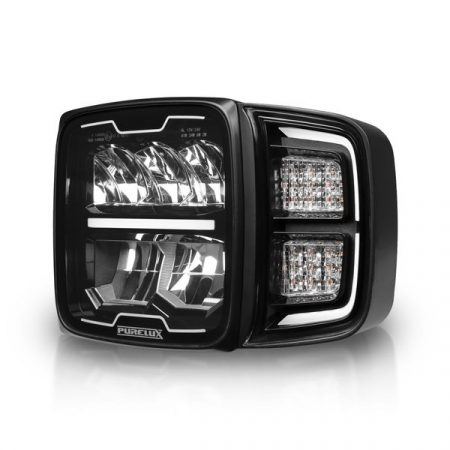
Long-distance coaches and intercity buses operate on demanding schedules across some of Europe’s most challenging road environments. A Scania Interlink running overnight routes through northern Finland or a Volvo 9700 on a cross-border Scandinavian run will cover tens of thousands of kilometres per year, often in darkness, heavy snowfall, and temperatures well below freezing. The right bus accessories serve two practical purposes: improving driver visibility and safety on the road, and maintaining the professional appearance of a fleet that represents its operator to passengers every day.
RST-Steel manufactures steel accessories for the most common coach and intercity bus models operating in the Nordic market, including Scania, Volvo, Setra, and Iveco. Every product is designed and manufactured in Nivala, Finland, to fit specific bus models — not adapted from generic truck or van accessories. All bus products are available on a quote basis. Fleet operators can request a quote directly, and RST-Steel’s sales team can assist with model identification, product selection, and installation coordination.
Roof bars and mounting systems for bus equipment
A bus roof bar provides a structurally secure mounting platform for auxiliary driving lights and position lights, fixed to the top of the cab area. On long-distance coaches operating on rural Finnish and Scandinavian roads, high-mounted auxiliary lighting significantly extends the driver’s visibility range — reducing accident risk on dark stretches between towns where road lighting is absent or minimal.
The critical factor is model-specific fit. A coach roof has a fundamentally different profile from a truck cab: different curvature, width, roof rail positions, and aerodynamic geometry. Generic truck roof bars do not seat correctly on coaches and create vibration, rattling, and incorrect light positioning. RST-Steel’s roof bars for buses are engineered for each specific model’s roof geometry.
Roof bar products by bus model
The current range covers the most common coach models in Nordic fleets. For Scania operators, the Roof Bar Basic V33 fits the Scania Interlink and OmniExpress, while the Work Light Bar Worker V07 is also available for the Scania Interlink. The Roof Bar Basic V78 fits the Scania Touring K410 from 2014 onwards.
For Volvo fleets, the Roof Bar Basic V41 covers the Volvo 9700 (2001 to 2018), and the Roof Bar Basic V55 fits the Volvo New Coach from 2018 onwards. The Takbøyle Iveco Viator and the Roof Bar Basic V01 for the Setra HD/HDH complete the range. The V-number designations (V01, V33, V41, V55, V78) are RST-Steel’s internal product codes, not bus generation numbers.
All bus roof bars are manufactured in stainless steel. For fleet equipment that must retain a professional appearance over years of outdoor exposure — road salt, ice, UV, pressure washing — stainless construction is the practical choice. It requires no painting or coating maintenance and does not corrode at the fastener points where painted steel typically fails first.
Essential protection and structural accessories for buses
Beyond roof-mounted equipment, buses benefit from structural accessories at the front of the vehicle. Front bars and front spoiler bars provide lower mounting points for auxiliary lighting while also contributing to the vehicle’s frontal appearance — a consideration that matters to fleet operators whose coaches are a public-facing asset.
Front bars
Front bars are mounted at or near the front bumper area, providing a lower mounting point for auxiliary driving lights than a roof bar delivers. Low-angle illumination is particularly effective in fog, heavy snowfall, and on rural roads with poor surface markings — conditions that are routine on Nordic winter routes. The front bars for buses range currently covers the Volvo 9700 and Scania models.
For the Volvo 9700, there are two distinct products: the Front Light Bar for Volvo 9700 (2007 to 2013) and the Front Light Bar 60mm for Volvo 9700 (2001 to 2013). The overlap in model years means the correct product depends on the specific vehicle configuration. Buyers with a Volvo 9700 from the overlapping period should contact RST-Steel directly to confirm which bar matches their vehicle. For Scania, the Front Light Bar for Scania Touring K410 (2014 onwards) and the Front Light Bar for Scania Interlink are available.
Front spoiler bars
Front spoiler bars, referred to as lowline bars in the product names, are positioned at the very front lower bumper line. The “Lowline” designation refers to the mounting position — lower than a standard front bar — not to a product generation. This low mounting angle produces a wide, flat beam pattern across the road surface, which is effective at revealing road edges, snow-covered lane markings, and animals crossing in front of the vehicle.
The current front spoiler bar range covers two Scania models: the Front Bumper Bar Lowline V14 for Scania Touring K410 and the Front Spoiler Bar Lowline V06 for Scania Interlink. Volvo and other bus operators looking for a lowline front bar for their specific model should enquire directly with RST-Steel about availability or custom options.
Lighting upgrades that improve bus safety and visibility
A roof bar or front bar without lights is a mounting structure. The lighting choice determines the actual safety benefit the installation delivers. For bus auxiliary lighting, RST-Steel recommends and supplies Lazer auxiliary lights — the same professional-grade lighting systems used across the truck and van range. RST-Steel is the official Finnish importer of Lazer Lamps.
Coaches cover high annual mileages across a variety of road types: motorways, regional roads, and rural routes. On dark Finnish and Scandinavian rural roads, the difference between standard factory high beams and a well-chosen pair of Lazer driving lights is measurable in both visibility range and beam pattern quality. Models in the Lazer Triple-R and Linear series produce an even, far-reaching beam that eliminates the patchy illumination of standard headlights and gives the driver meaningful additional reaction time when an animal crosses the road or a hazard appears ahead.
For bus roof bar and front bar mounting, driving lights in spot or combination beam configurations are the most relevant category. The full Lazer auxiliary lights range is available through RST-Steel, and the sales team can recommend the appropriate model for a specific bus and bar combination. The right match depends on the mounting height, the bar geometry, and the primary use case — motorway driving, rural night routes, or mixed conditions.
How Nordic conditions shape bus accessory requirements
The Nordic operating environment places specific demands on bus equipment that suppliers in other markets do not always account for. Finnish and Scandinavian winters combine extreme cold, heavy snowfall, road salt, and long periods of complete darkness. Equipment that performs adequately in central European conditions can fail early, corrode visibly, or lose structural integrity in these conditions.
Stainless steel construction is the standard RST-Steel uses across its bus accessory range for this reason. Road salt is the primary cause of premature corrosion on vehicle accessories — it accelerates rust at welds, fastener points, and surface scratches. Stainless steel resists this without requiring annual treatment or coating maintenance. For a fleet operator running vehicles on a ten-year service cycle, the difference in maintenance cost and appearance retention is significant.
The fit-to-model approach also reflects Nordic operating realities. A bus accessory that vibrates at highway speeds or shifts position under thermal expansion and contraction creates noise complaints from passengers and potential safety issues. RST-Steel’s bus accessories are designed and tested for specific models under Finnish conditions — not adapted from catalogues developed for warmer climates with different road surfaces and seasonal variation.
Professional installation vs. self-fitting bus accessories
Bus accessories can, in principle, be fitted by a workshop with the right tools and access to the vehicle. In practice, the decision between professional installation and self-fitting comes down to three factors: technical complexity, regulatory compliance, and fleet management efficiency.
Roof bar installation on a coach requires working at height, correct torque on roof rail fasteners, and proper routing of wiring for auxiliary lights. Incorrect installation at roof level creates vibration that transmits through the entire vehicle structure and can cause rattling that is difficult to diagnose and correct after the fact. Front bar installation requires correct positioning relative to the bumper geometry and secure attachment that does not compromise the structural integrity of the front end. These are not difficult tasks for an experienced workshop, but they require the right knowledge of the specific bus model.
For fleet operators equipping multiple vehicles, professional installation through RST-Steel’s installation locations in Pirkkala and Kempele is the more efficient path. Coordinating delivery, installation, and quality control through a single supplier reduces the administrative burden and ensures consistent results across the fleet. RST-Steel handles the full process from product supply through to completed installation, and the sales team can coordinate scheduling for multi-vehicle orders.
Bus accessories for the models covered in this guide are available on a quote basis. Fleet managers equipping a single vehicle or a full fleet can contact RST-Steel at sales@rst-steel.fi or through the quote request page to discuss requirements, confirm model compatibility, and receive pricing. The full bus accessories range covers Scania Interlink/OmniExpress, Scania Touring K410, Volvo 9700, Volvo New Coach, Iveco Viator, and Setra HD/HDH, with roof bars, front bars, and front spoiler bars manufactured in stainless steel for each specific model.

 Norwegian
  English
  Swedish