Cosmetic damage — scratches, small surface marks, and loose fixings — can often be dealt with without replacing the bar. Structural damage, including cracked welds, bent main tubes, deformed brackets, and damaged mounting points, usually means the bull bar should be replaced. Always have the vehicle’s own mounting points checked by a workshop after any impact, regardless of how minor it looks.
How to check a bull bar after a collision
Start with a close visual inspection before the vehicle moves again. Walk around the front of the truck and look at the bull bar from multiple angles to spot any change in alignment or obvious deformation.
Check every tube for bends, kinks, or twists. A tube that looks only slightly off may have taken enough force to compromise the whole bar.
Inspect every weld carefully. Cracks in welds are not always wide or obvious — look for paint lifting, rust lines, or fine fractures running along or across a weld bead.
Examine the brackets and mounting points. Look for deformation, cracks, or bolt holes that have become elongated. Any of these signs points to structural damage.
Check that all fixings are tight and that no bolts are missing or sheared. A loose bar is a safety hazard even if the bar itself is undamaged.
If lights or accessories are mounted on the bar, check their brackets separately. A bracket that has bent or cracked counts as damage even if the main bar looks fine.
Finally, have a workshop inspect the vehicle’s own mounting points and front structure. Impact forces travel through the bar into the chassis, and damage there is not visible from outside.
Bull bar damage you can usually repair vs damage that needs replacement
| Usually repairable | Usually needs replacement |
|---|---|
| Surface scratches and minor cosmetic marks | Cracked welds |
| Loose bolts | Bent or kinked main tubes |
| Damaged or loose light brackets that are separate bolt-on parts | Deformed mounting brackets |
| Damage at the mounting points | |
| Any damage that changes the bar’s shape or alignment |
If you are unsure which column the damage belongs in, treat it as structural and have it checked by a professional before driving.
Should you weld or straighten a damaged bull bar?
Straightening or welding a structural component changes the metal’s properties and alters how it behaves in a subsequent impact. A bar that has been bent and straightened may look correct but will not necessarily perform the same way it did when new.
For a road-approved bull bar, it is worth contacting the manufacturer before carrying out any structural repair. Road approval is based on the bar as it was originally manufactured and tested, and a structural modification may affect that status. The manufacturer is best placed to advise whether a repair is appropriate or whether replacement is the right course.
Cosmetic work — touching up surface marks or replacing a separate bolt-on bracket — is a different matter and does not raise the same concerns.
Repair or replace: how to decide
The starting point is the type of damage. Cosmetic damage, such as scratches or a loose bracket, does not affect the bar’s protective function and can usually be addressed without replacement. Structural damage affects how the bar performs in the next impact and is a strong indicator that replacement is the safer choice.
Consider whether the mounting points are affected. If the connection between the bar and the vehicle has been damaged, the entire system is compromised. Repairing a bar and refitting it to damaged mounting points does not restore the original level of protection.
If the bar carries road approval, factor that into the decision. A structural repair carried out without the manufacturer’s input may affect the approval, which matters for commercial operators.
Think about the cost of downtime. For a working truck, time off the road has a direct business cost. A repair that takes multiple attempts or fails under a subsequent impact costs more in the long run than a clean replacement.
When the damage is structural, replacement is generally the right answer.
What is a crash bar, and is it the same as a bull bar?
A crash bar on a car is the reinforcement beam that sits behind the bumper cover. It is part of the vehicle’s own crash structure, engineered to absorb and distribute impact energy in a collision. After a significant impact, a damaged crash bar is normally replaced rather than repaired, because its geometry and material properties are critical to how it performs. Crash bar repair is generally not recommended for structural damage; replacement is the standard approach.
A bull bar is an external accessory mounted in front of the bumper. It is an add-on, not part of the vehicle’s crash structure.
The terms push bar and nudge bar are commonly used for smaller front protection bars. The same principle applies to all of them: cosmetic damage can be addressed, but structural damage means the bar should be replaced.
| Part | Where it sits | Repair or replace after damage |
|---|---|---|
| Crash bar (bumper reinforcement) | Behind the bumper cover, part of the vehicle’s crash structure | Replace after structural damage |
| Bull bar | External accessory in front of the bumper | Repair cosmetic damage; replace after structural damage |
| Push bar / nudge bar | External accessory in front of the bumper | Repair cosmetic damage; replace after structural damage |
Do bull bars help in an accident?
A bull bar can reduce damage to the grille, headlights, and cooling system in animal strikes and low-speed impacts — situations that are a real risk for trucks on rural and highway routes. In those scenarios, a well-fitted bar can prevent expensive damage to components that sit directly behind the bumper. A bull bar is not an occupant crash-safety device, however, and it does not replace or improve the vehicle’s built-in safety systems. Its benefit is protection of the front of the truck, not the people inside it.
Replacing a damaged bull bar on a truck
Bull bars are made for a specific make, model, and cab configuration, so a replacement must match your exact truck. Fitting a bar designed for a different vehicle is not a safe or compliant solution.
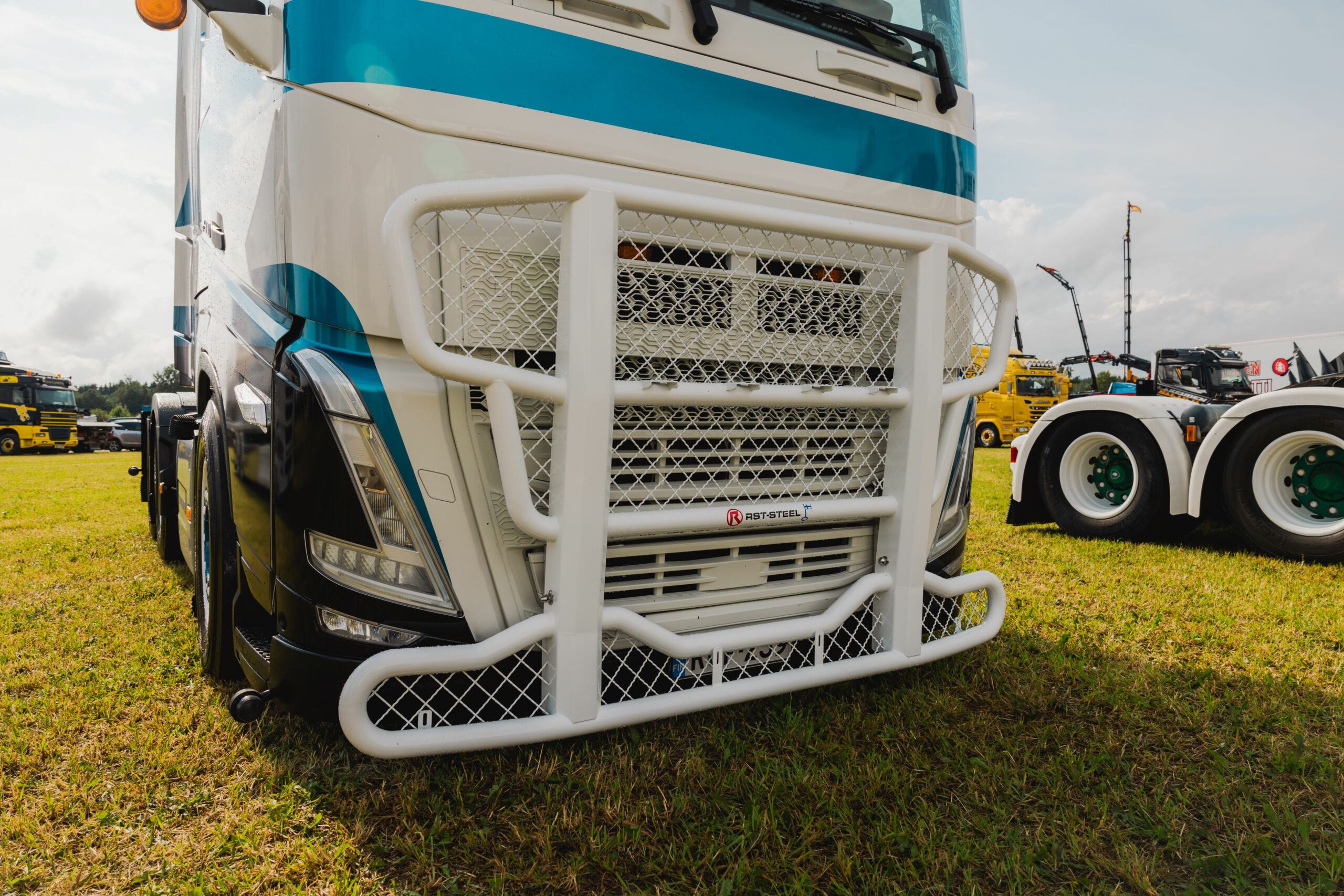
RST-Steel bull bars are manufactured in Finland from stainless steel. RST-Steel states it is the only manufacturer in Finland offering officially road-approved bull bars. Replacement bars are available for the following makes:
Frequently asked questions
Can a bull bar be repaired after hitting an animal?
It depends on the damage. A collision with a large animal — a moose or deer, for example — can transfer significant force into the bar. Surface marks and loose fittings can often be dealt with, but bent tubes, cracked welds, or deformed brackets mean the bar should be replaced. Have the vehicle’s mounting points checked at the same time.
Can a crash bar be replaced?
Yes. A crash bar — the reinforcement beam behind the bumper cover — is a standard replacement part. After a collision that has deformed or cracked it, replacement is the normal course of action. Crash bar repair is not generally recommended for structural damage because the part’s shape and material integrity are critical to its function.
Should I remove a damaged bull bar before driving?
If the bar is loose, visibly bent, or sitting at an angle, it should be secured or removed before the vehicle moves. A bar that is no longer properly attached can shift under braking or at speed and cause additional damage. If you are in any doubt about whether the bar is safe to drive with, have it checked before setting off.
Can scratches on a stainless steel bull bar be removed?
Light surface scratches on a stainless steel bull bar can often be addressed using appropriate stainless steel finishing products, working in the direction of the original grain. Deeper scratches may require professional attention. Stainless steel does not need paint or coating to resist corrosion, which makes surface restoration more straightforward than with painted steel bars.
Need a replacement bull bar for your truck? Request a quote or contact us to find the right bar for your make and model.