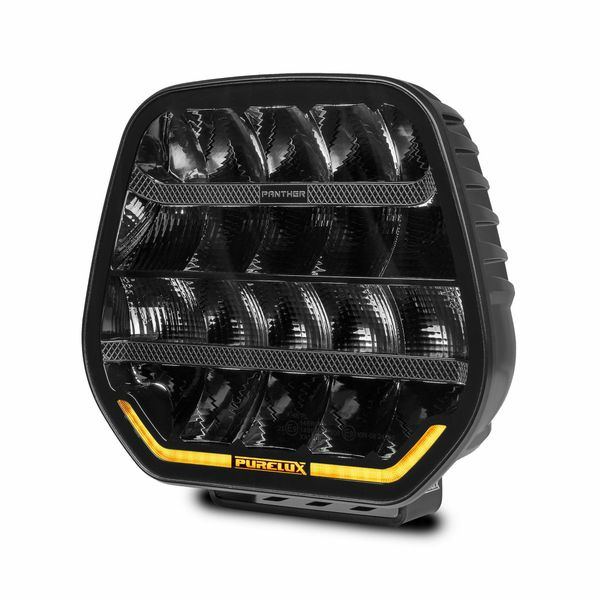

The headlight Kelvin scale describes correlated colour temperature (CCT), which is the apparent colour of a light source, not how bright it is. A 3000K auxiliary light looks warm yellow, a 4000K light looks neutral white, and a 6000K light looks cool blue-white. Kelvin tells you nothing on its own about how far a light throws, how much road it illuminates or how well it performs in bad weather. This guide explains what Kelvin values mean, how colour temperature affects what drivers perceive, and where Kelvin fits alongside lumens, lux, beam pattern and colour rendering.
What does the headlight Kelvin scale actually measure?
Kelvin measures the apparent colour of light, not its brightness or its range. The scale comes from physics: a theoretical black body heated to a given temperature glows with a particular colour, and the Kelvin number describes that temperature. Lower values look warmer and more yellow, while higher values look cooler and bluer. Because LED auxiliary lights do not glow from heat, their rating is a correlated colour temperature, meaning the nearest matching black-body colour.
Two lights can share the same Kelvin rating and still perform very differently. One may produce a few hundred lumens through a poor reflector, while another produces several thousand lumens through a precision optic. For this reason, auxiliary light colour temperature should be treated as one specification among several, never as a measure of quality or power.
What are warm white, neutral white and cool white light?
Lighting is usually grouped into three broad colour temperature bands. The boundaries are conventions rather than strict standards, and manufacturers label their products slightly differently.
- Warm white (about 2700K–3500K): a yellow to amber-white tone, similar to traditional halogen and incandescent bulbs.
- Neutral white (about 3500K–5000K): a clean white with little visible yellow or blue tint.
- Cool white (about 5000K and above): a crisp white that moves towards blue as the value rises, resembling daylight at the lower end and a distinctly blue tint at the top end.
For vehicle use, the practical range is narrower than the full scale. Most auxiliary lights are sold between roughly 3000K and 6500K, and values well above that tend to look noticeably blue rather than white.
How do 3000K, 4000K, 5000K and 6000K compare?
The table below is an illustrative guide to how each colour temperature typically appears. It describes approximate appearance only. It does not promise any level of performance, because real-world results depend on the optic, output, lens, mounting position and conditions.
| Colour temperature | Approximate appearance | Common description | Typical use |
|---|---|---|---|
| 3000K | Warm yellow-white | Warm white | Fog lights, low-mounted lamps |
| 4000K | Neutral white with a slight warmth | Neutral white | Work lights, mixed-condition driving |
| 5000K | Clean white, close to neutral daylight | Neutral to cool white | General-purpose auxiliary lights |
| 6000K | Cool white with a faint blue tint | Cool white | Spot and driving lights |
| 6500K and higher | Distinctly blue-white | Very cool white | Mainly a styling choice |
Note that the usual comparison of 3000K vs 4300K vs 5000K vs 6000K should be read as a spectrum of appearance, not a ranking. A 4300K light sits between warm and neutral and looks only slightly warmer than 4000K to most people. No single step on this scale is universally best.
How does colour temperature affect perceived visibility, contrast and comfort?
Human colour perception explains most of what drivers notice. In dim conditions the eye relies increasingly on rod cells, which are more sensitive to blue-green wavelengths. This is one reason cooler light can look brighter at night even when its measured output is no higher. The effect is real, but it describes perception, not the actual amount of light reaching the road.
Cooler light often gives a stronger sense of contrast on dry roads, because road signs, markings and pale objects look crisp against dark surroundings. Warmer light tends to feel softer and can be more comfortable over long periods, particularly in the driver’s peripheral vision and when reflecting off nearby surfaces. Comfort is personal. Some drivers find very cool light harsh after hours at the wheel, while others find warm light dull.
It is also worth separating perceived brightness from usable visibility. A light that looks bright and white is not necessarily lighting the road more effectively. Glare, beam shape and how much light lands on the surface ahead all influence whether a driver can actually see hazards in time.
Why can’t Kelvin alone predict performance in rain, fog or snow?
A common claim is that warm light always cuts through fog and cool light always fails in rain. The reality is more nuanced. Fog, rain and snow scatter light because of the droplets and particles themselves, and the amount of scatter depends heavily on beam geometry, mounting height, output level and how much light is aimed into the airborne water rather than at the road.
Warmer light is often reported by drivers to feel more comfortable in fog because it can look less glaring against a bright, scattering background. That is a perception of comfort, and it should not be read as proof that a particular Kelvin value improves safety. A well-designed fog beam pattern at 5000K can outperform a poorly designed beam at 3000K. Likewise, white snow reflects light strongly, so glare control and aiming matter more than the exact colour temperature.
For a deeper look at weather behaviour, see our article on how auxiliary lights behave in fog or rain.
How does Kelvin compare with lumens, lux, wattage, beam pattern and colour rendering?
Kelvin is only one of several specifications, and each one answers a different question.
- Kelvin: the apparent colour of the light.
- Lumens: the total light emitted by the source. It says nothing about where that light goes. Our guide on how many lumens auxiliary lights should provide covers this in detail.
- Lux: the light actually arriving on a surface at a given distance. This is closer to real-world usefulness than lumens.
- Wattage: the electrical power consumed. It indicates energy use and heat, not light quality, because efficiency varies between designs.
- Beam pattern: how the optic shapes and aims the light, whether as a long narrow spot, a wide flood or a combined beam. This often matters more than colour temperature.
- Colour rendering (CRI): how faithfully the light shows the true colours of objects. Two lights at the same Kelvin value can render colours very differently.
When comparing products, check lux at distance and beam pattern before worrying about whether a light is 5000K or 6000K.
Why doesn’t a higher Kelvin value automatically mean better visibility?
Higher Kelvin simply means a bluer-looking light. It does not add output, range or clarity. Very cool light can increase glare for the driver and for oncoming traffic, scatter more strongly off wet surfaces and airborne moisture, and cause eye fatigue over long periods. It can also make colours look less natural, which matters when you need to identify cargo, wiring or fluid leaks.
The belief that blue-white means better visibility usually comes from the perceived-brightness effect described above. Perceived brightness and measurable road illumination are not the same thing, so a high Kelvin rating should never be used as a shortcut for quality.
What colour temperature suits trucking, rural roads, winter conditions and work areas?
These are general considerations rather than guarantees, and personal comfort should guide the final choice.
- Professional truck driving: long hours make visual comfort important. Neutral white in the 4000K–5000K range is a common compromise because it balances contrast with reduced fatigue across changing conditions.
- Rural roads: unlit roads with wildlife and uneven surfaces reward a well-shaped beam and sufficient lux at distance. Neutral to cool white is widely used, with beam pattern doing most of the work.
- Winter conditions: falling and reflected snow makes glare control a priority. Many drivers prefer neutral or slightly warm light and a well-aimed beam over very cool light.
- Working environments: loading, unloading and maintenance depend on accurate colour rendering. Neutral white with a good CRI helps you distinguish materials, tools and hazards.
For a concise decision guide to picking a value, read our companion article on how to choose the right Kelvin value for a vehicle’s auxiliary lights.
What should you check before buying an auxiliary light?
Use this short checklist when comparing products:
- Confirm the Kelvin rating, but treat it as a comfort and appearance preference.
- Check lumens and, where published, lux at a stated distance.
- Choose a beam pattern (spot, flood or combo) that fits where you drive.
- Look for a stated colour rendering index if you need accurate colours for work.
- Check the lens and housing quality, ingress protection rating and mounting options.
- Confirm the light is legal for your intended use and wired correctly for your vehicle.
Our auxiliary lights complete buying guide expands on each of these points.
Which auxiliary lights does RST Steel offer?
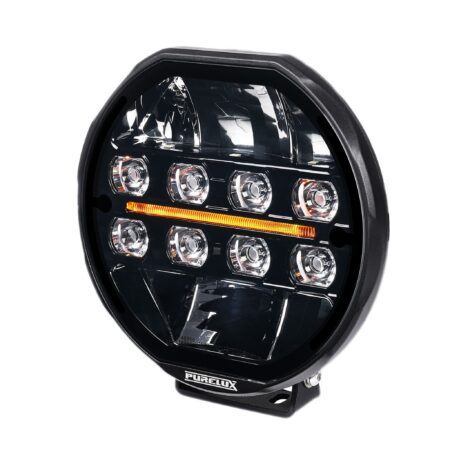
We offer auxiliary lighting solutions across all price ranges to meet professional drivers’ diverse needs, and you can browse the full auxiliary lights range. Lazer Lamps represent our premium option, delivering exceptional performance and superior build quality for demanding applications, and you can view them in our Lazer Lamps collection. Our mid-range Purelux and OZZ models provide excellent value with reliable performance for most professional requirements. Optibeam lights offer cost-effective solutions for budget-conscious drivers without compromising essential safety features.
If you would like help matching a colour temperature, beam pattern and brand to your driving conditions, contact us to discuss your requirements, or request a quote.
Frequently asked questions about Kelvin and auxiliary lights
What is the best Kelvin for headlights and auxiliary lights?
There is no single best value. Neutral white between about 4000K and 5000K is a popular all-round choice because it balances contrast and comfort, but the right option depends on your conditions, the beam pattern and personal preference.
Does a higher Kelvin rating make a light brighter?
No. Kelvin measures colour, not brightness. Brightness is described by lumens and lux, and a higher Kelvin value only makes the light look cooler and bluer.
Is 3000K better than 6000K in fog?
Not automatically. Warmer light is often found more comfortable in fog, but performance depends mainly on beam pattern, mounting position and output. Kelvin alone cannot guarantee better visibility in any weather condition.
Why does cool white light look brighter at night?
In low light the eye is more sensitive to blue-green wavelengths, so cooler light can appear brighter than warmer light of the same measured output. This is a perception effect and does not mean more light is reaching the road.
What is the difference between Kelvin and colour rendering?
Kelvin describes the overall colour tone of the light, while colour rendering (CRI) describes how accurately the light shows the true colours of objects. Two lights with the same Kelvin rating can have very different CRI values.
Can two auxiliary lights with the same Kelvin value perform differently?
Yes. Differences in lumen output, optics, beam pattern, lens quality and efficiency mean that equal Kelvin ratings can still produce very different real-world results.